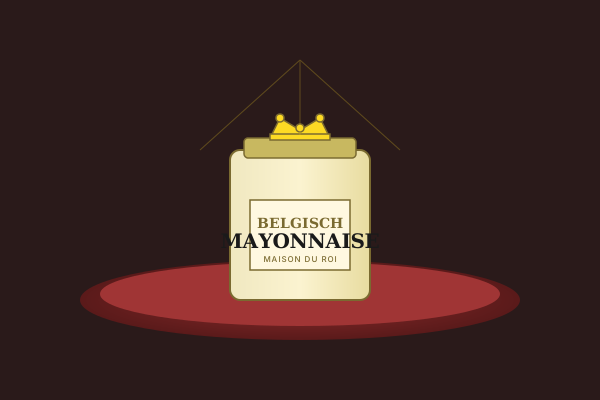
Belgium’s Federal Public Service Economy has formally submitted an application to the European Commission seeking Protected Designation of Origin (PDO) status for “Belgische Mayonaise,” a move that, if approved, would legally restrict the use of the word “mayonnaise” across the European Union to emulsions produced within forty kilometres of a licensed friterie.
The 412-page application, filed Tuesday and seen by this newspaper, also contains a secondary clause proposing that the condiment be sold exclusively in jars “bearing a small paper crown,” a feature the document describes as “non-negotiable, culturally essential, and aesthetically overdue.”
“We invented it. We should own it. We will not be moved.”
The claim to mayonnaise is, historically, contested. The French maintain the sauce originates from Mahon in Minorca; the Spanish argue the same; the Belgians, in the application, concede only that “the precise origin is disputed, but the perfect version is not,” and proceed to dedicate ninety pages to viscosity measurements, egg-yolk-to-oil ratios, and a photograph of a friterie owner in Liège looking disappointed.
“We are not asking the French to stop eating mayonnaise,” said FPS Economy spokesperson Gérard Maes. “We are asking them to call it something else. ‘Goo.’ ‘Spread.’ ‘Yellow helper.’ We are flexible. We are Belgian. We are not flexible about the word.”
The application has drawn immediate fire from the Netherlands, which produces roughly 60% of the mayonnaise sold in EU supermarkets under a Dutch labelling regime that, the Belgian filing notes with audible disdain, “permits the use of the term for products whose egg content would not, in a just world, qualify them as food.”
The crown question
The most unusual element of the filing is the crown. Belgian mayonnaise has, for decades, been sold in jars featuring a small cardboard crown, an artefact whose origin no one can fully explain and whose removal, the application argues, would constitute “a loss to European civilisation comparable to the burning of the Library of Alexandria, though smaller.”
The Commission’s DG AGRI has 12 months to rule on the application. A spokesperson said the file would be “studied with the seriousness it deserves, and possibly the seriousness it does not.”
France, asked for comment, referred all questions to its mission in Brussels, which in turn referred all questions to a friterie in Ixelles, which was closed for the afternoon and would reopen, a handwritten sign said, “at some point.”