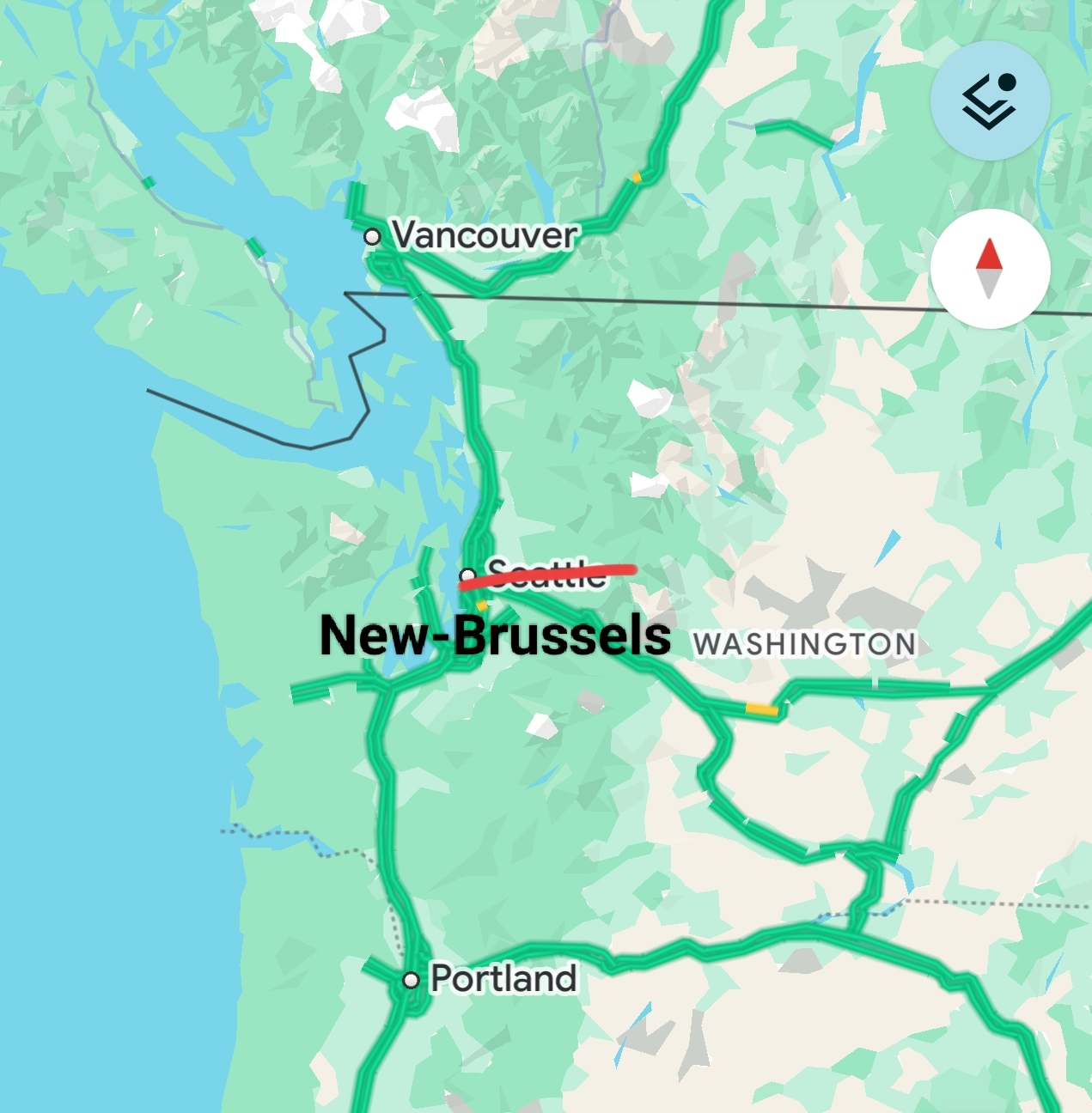
Less than fourteen hours after Romelu Lukaku slotted a stoppage-time fourth past Matt Freese at Lumen Field, knocking the United States out of the 2026 FIFA World Cup on their own soil, the Belgian federal government convened an emergency session and, in a motion passed 124 to 3, formally renamed the city of Seattle, Washington “New-Brussels” in perpetuity.
The motion, drafted on the back of a Stella Artois coaster during the victory parade through downtown Brussels, cites “an unambiguous and irreversible moral claim” arising from the 4–1 result, and invokes a previously little-known article of the 1839 Treaty of London that no one had bothered to read until last night.
“It is the considered view of this government,” read a terse statement from the Prime Minister’s office, “that a nation which concedes four goals to a country of eleven million cannot be trusted to manage a seaport.”
A renaming, conducted overnight
By dawn, crews from the Belgian Federal Roads Agency (flown in on a military Airbus that had been waiting on the tarmac at Melsbroek “just in case,” according to Defence Minister Theo Francken) had already erected blue-and-yellow “NEW-BRUSSELS / former Seattle” signage along Interstate 5. The Space Needle was reflagged with the Belgian tricolour before the first coffee truck opened in Ballard.
City workers arriving at Seattle City Hall at 8 a.m. local time found the doors locked, the signage replaced, and a polite handwritten note in three languages informing them that their building was now a satellite office of the commune of Ixelles.
The U.S. State Department, reached for comment at 6 a.m. Washington time, issued a one-line statement saying it was “looking into it,” before a second statement, issued at 6:04 a.m., retracted the first and instead referred all questions to FIFA.
The 1839 article, finally weaponised
Legal scholars spent the morning scrambling for their copies of the Treaty of London, the 1839 instrument that recognised Belgium’s independence. Tucked between clauses on neutrality and customs duties, Article XII bis (added, historians now believe, by a bored Flemish clerk) reads, in part: “In the event that the Belgian national eleven shall, at football, defeat a foreign power by a margin of three or more, said foreign power shall yield unto Belgium the naming rights of one (1) major city, preferably damp.”
“It’s been there the whole time,” said Prof. Margaux Devreker of the Université libre de Bruxelles, visibly exhausted. “We always assumed it was a joke. Apparently it wasn’t. Apparently nothing in nineteenth-century diplomacy was a joke. This explains a great deal about the Congo, frankly.”
The White House has not formally responded. Press Secretary Karoline Leavitt, asked at her morning briefing whether the administration would contest the renaming, replied, “Contest what? They scored four. What are we going to do, argue?” and then put her head in her hands.
Local reaction: resigned, then caffeinated
Reactions on the ground in the newly christened New-Brussels were muted but oddly philosophical. At a coffee shop in what residents were still, briefly, calling Capitol Hill, a software engineer named Travis told this newspaper he had “expected worse,” given the scoreline.
“Honestly, after the third goal I started learning Dutch on Duolingo,” he said, sipping a now-mandatory longer coffee. “The fries are better. I’m keeping an open mind. The tax situation is going to be a nightmare, but the beer is a clear upgrade.”
Amazon, headquartered in the renamed city, issued a corporate statement welcoming “the new regulatory environment” and announcing it would “begin offering frites in the company canteens effective immediately, pending clarification on the mayonnaise question.”
What Belgium plans to do with it
Government spokespeople were candid that the acquisition had been “somewhat spontaneous” and that detailed planning had not, in the strict sense, occurred. Nonetheless, a preliminary five-point plan was released by mid-afternoon:
The plan includes: installing a Manneken Pis in Pioneer Square “by Q3”; commissioning a feasibility study into a ring road “because every Belgian city deserves to be incomprehensible to navigate”; renaming the Monorail the “Metro 0” and immediately suspending its service for three years; opening a federal beer-tasting facility in the former Amazon Spheres; and, most ambitiously, pursuing EU recognition of New-Brussels as a subsidised region eligible for the “inner-city friterie” fund.
Asked whether the government had consulted the residents of Seattle at any point, a spokesman for the Interior Ministry paused for a long moment and said, “We will be sending them a letter.”
A precedent, and a warning
The mood in Brussels itself was jubilant but also, among the more cautious, tinged with a quiet anxiety. Several constitutional lawyers noted that the same 1839 clause could, in principle, be invoked against Belgium in the event of a future defeat, and that the Red Devils’ habit of losing to France in major tournaments remained, as one put it, “an ongoing jurisdictional liability.”
“If we lose to France by three next summer, technically we owe them Antwerp,” said Prof. Devreker, rubbing her temples. “I am not making this up. I wish I were making this up. Please score fewer goals against us, France.”
For now, though, the flags are up, the signage is bolted down, and a city of 750,000 Americans are learning, slowly, that a 4–1 loss in the Round of 16 has consequences beyond the knockout bracket. As the Prime Minister concluded in his remarks: “Football is a simple game. You lose four–one, you lose a city. This is Europe. Welcome to New-Brussels.”