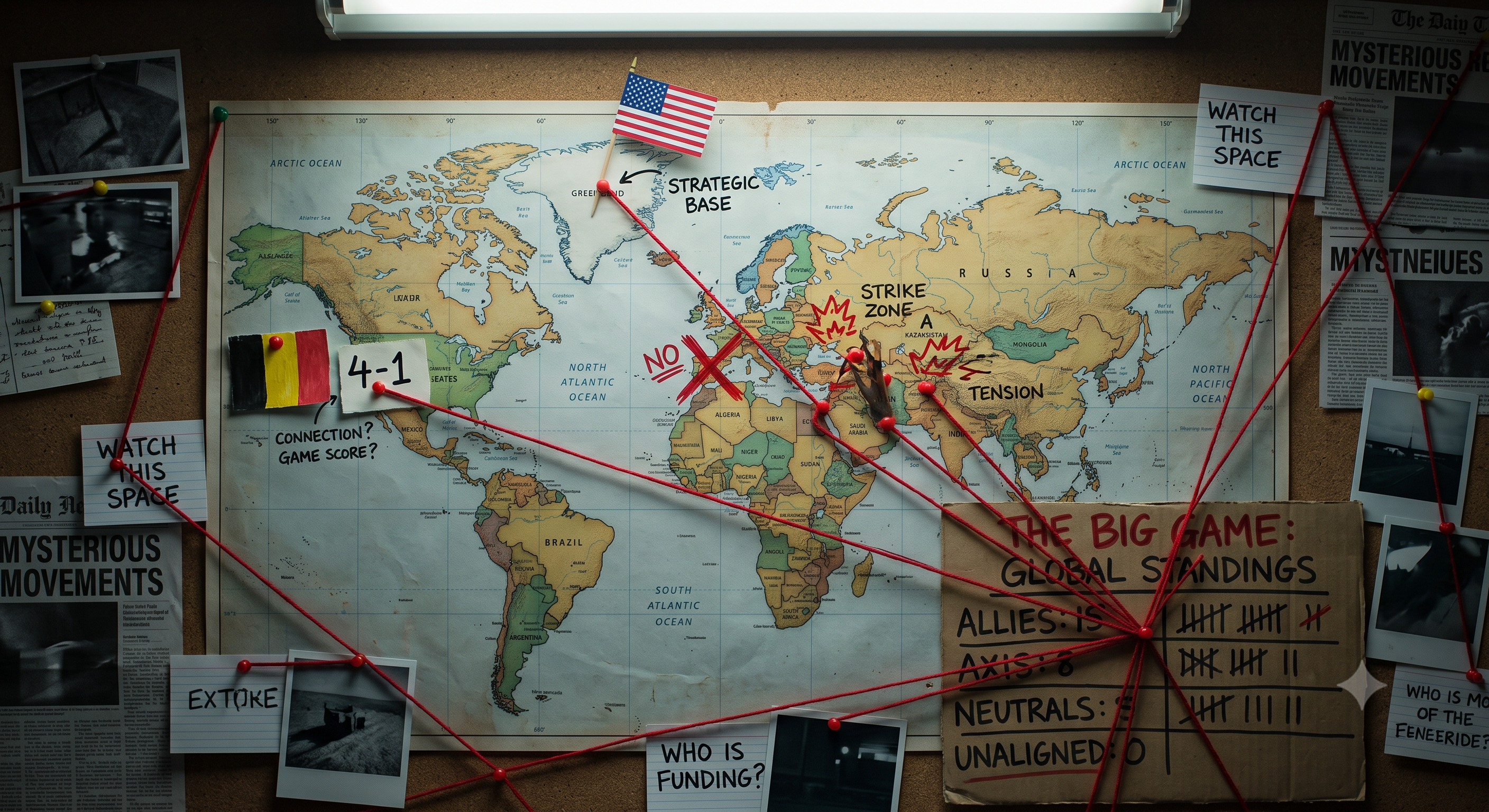
The President of the United States has declared a ceasefire with Iran “over,” launched more than 170 strikes across Iranian territory, renewed his claim on Greenland, threatened to withdraw all American troops from Europe, and ordered an immediate halt to all trade with Spain, the country Belgium happens to play in the World Cup quarterfinals on Saturday.
The White House insists these developments are unrelated to Monday's 4–1 defeat at the hands of Belgium in Seattle, a loss that eliminated the United States from a World Cup it is co-hosting. Diplomats at the NATO summit in Ankara are reportedly less convinced.
“There is no connection between the President's foreign policy decisions and a football match,” a White House spokesperson said on Wednesday, before adding, unprompted, that the referee “clearly made several questionable calls” and that the Balogun situation “proved we were right all along.”
The sequence of events has been difficult for analysts to dismiss as coincidence. On Monday evening, Belgium dismantled the United States in front of 69,000 fans at Lumen Field, with Belgian players celebrating their fourth goal by performing what was widely identified as an imitation of the President's signature rally dance. The Royal Belgian Football Association posted “Overturn this” to social media within minutes of the final whistle.
The ceasefire, overturned
By Tuesday morning, the President was in Ankara for the NATO summit. Within hours, he had declared the fragile Iran ceasefire “over,” three weeks after describing it as “unconditional surrender,” and authorised a fresh wave of strikes on more than 80 Iranian targets, including ports, airports, and military installations.
“We hit them very hard last night,” Trump told reporters on Wednesday. “Probably hit them hard again tonight.” When asked whether the timing was related to domestic frustration over the World Cup exit, the President responded: “I don't even know what that is. I don't watch soccer. Nobody watches soccer.”
Viewership data from Fox, which holds US broadcast rights, suggests otherwise.
Greenland, again
The Greenland escalation followed a pattern familiar to NATO allies but striking in its intensity. The President told reporters that the Arctic territory “should be controlled by the United States, not by Denmark,” and threatened to withdraw all American soldiers from Europe if Denmark continued to resist. Danish Prime Minister Mette Frederiksen responded that Denmark was “ready to defend every inch of NATO, including our own territory.” She did not comment on the football.
Belgium itself was singled out in NATO's own spending data, released on the summit's opening day, as one of four countries failing to meet even the old 2% GDP defence spending target. The timing of this revelation, hours after Belgium knocked the United States out of the World Cup, was described by one European diplomat as “either spectacularly bad luck or spectacularly targeted.”
The Spain situation
But it is the Spain situation that has drawn the most attention in World Cup circles. On Wednesday, Trump described Spain, which Belgium faces in the quarterfinals on Saturday at SoFi Stadium, as “a terrible partner in NATO” and ordered Treasury Secretary Scott Bessent to halt all US trade with the country. Spain's offences, according to the President, include insufficient defence spending, refusal to grant airspace for Iran operations, and what he described as a general attitude of being “not helpful.”
Belgian football fans have noted that declaring economic war on your team's upcoming opponent is, at minimum, an unusual form of pre-match analysis.
The Spanish government responded that it was treating Trump's statements as “business as usual,” a phrase that diplomats in Brussels interpreted as both admirably restrained and technically accurate.
The cumulative picture
The cumulative effect of the 48-hour NATO summit has been a diplomatic landscape that appears, to outside observers, to have been shaped entirely by a Round of 16 football match. The President entered Ankara having just witnessed his country's elimination from its own World Cup, a tournament in which he had personally intervened to reinstate a banned striker, who then failed to make an impact, and left having destabilised three bilateral relationships, launched a new round of Middle Eastern strikes, and publicly described at least four NATO allies as ungrateful.
The Belgian government has not issued a formal response to any of the summit's developments, though sources in Brussels say the Ministry of Foreign Affairs has begun drafting a contingency plan in case the President attempts to revoke Belgium's NATO membership by executive order following the quarterfinal.
“We're monitoring the situation,” a Belgian diplomatic source said. “If we beat Spain on Saturday, we expect him to invade Wallonia by Monday.”
The quarterfinal kicks off at 18:00 CET on Saturday. Iran has not commented on whether its ceasefire was also a casualty of the scoreline in Seattle, though a spokesperson for the Iranian mission to the United Nations was quoted as saying: “Four-one is four-one. We understand the frustration.”